
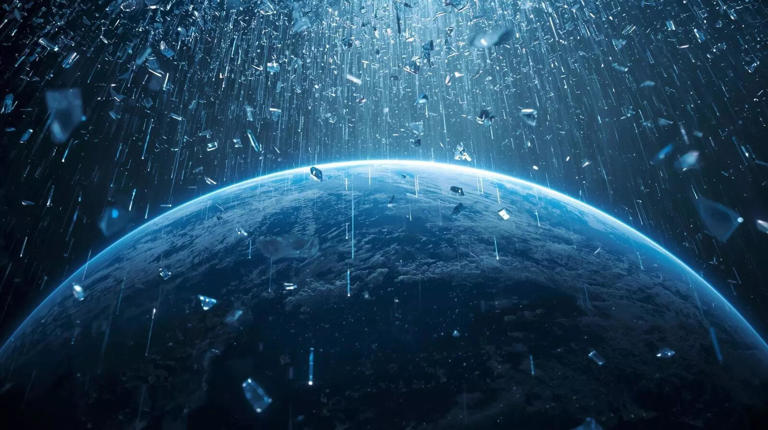
Deadly Glass Rain on a Blue Planet: NASA’s Shocking Discovery of HD 189733 b
In one of the most unusual planetary discoveries in recent years, scientists have revealed that a distant exoplanet — while looking deceptively similar to Earth from afar — has some of the most extreme and hostile weather conditions ever observed. The alien world, called HD 189733 b, has stunned researchers with violently fast winds and rain made of glass, making it a truly alien environment unlike anything on Earth.
A Cobalt Blue Planet That Isn’t What It Seems
HD 189733 b, located about 63 light-years away in the constellation Vulpecula, may appear blue when seen through powerful space telescopes, leading some to loosely compare its color to that of Earth’s oceans. But that comparison ends with its appearance. The blue color doesn’t come from water or life-friendly conditions — it comes from a dense atmosphere filled with silicate particles that scatter light in a way similar to Earth’s skies, but under radically different conditions.
Unlike Earth, this enormous world is a “hot Jupiter” — a gas giant larger than our own Jupiter that orbits extremely close to its star, completing a full orbit in just about 2.2 Earth days.
Extreme Winds and Deadly Glass Rain
What makes HD 189733 b truly extraordinary is its fierce weather. The planet’s atmosphere is buffeted by hurricane-like winds reaching up to 5,400 mph (about 8,700 km/h) — nearly seven times faster than the speed of sound on Earth. These incredible winds whip the atmosphere into a frenzy, making the conditions wildly unstable and completely uninhabitable.
But the strange weather doesn’t stop there. As the silicate particles in the atmosphere cool, they can condense into tiny glass droplets. These shards of glass don’t fall gently like rain on Earth. Instead, they are blasted sideways by the supersonic winds, creating a deadly storm that scientists have dramatically described as “rain of glass.” On a planet like this, getting caught in such a storm would be more than an inconvenience — it would be catastrophic.
What This Means for Exoplanet Studies
Although HD 189733 b is a hostile environment, it offers a valuable opportunity for astronomers to understand how planetary atmospheres behave under extreme conditions. By studying how these winds and atmospheric particles interact, scientists gain insight into the vast diversity of worlds beyond our solar system — even if some of them are entirely uninhabitable.
The striking contrast between this glass-raining planet and our own Earth reminds us that appearances can be deceiving in space. A world that looks somewhat familiar from afar can hide environments that are utterly alien and hostile.
Final Thoughts
NASA’s ongoing research into exoplanets like HD 189733 b continues to expand our understanding of planetary systems across the galaxy. While the image of a blue planet might stir the imagination, the reality of its extreme weather — with winds faster than sound and shards of glass falling like rain — makes HD 189733 b one of the most fascinating and fearsome worlds ever discovered.
One thought on “This blue planet possibly resembling Earth experiences rain of glass at 5400 mph, says NASA”