
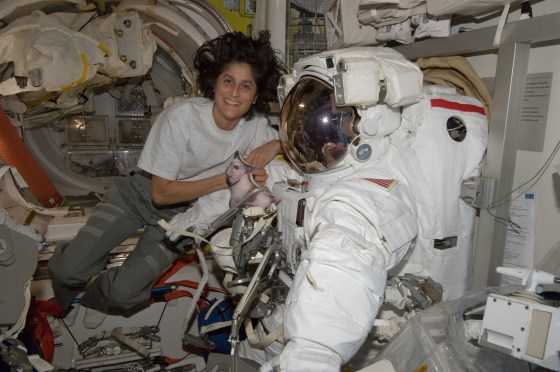
Hey there, space enthusiasts! If you’ve ever dreamed of floating among the stars or wondered what it takes to push the boundaries of human achievement, the story of NASA astronaut Suni Williams is one that’ll leave you inspired. After an incredible 27 years with NASA, Williams officially hung up her spacesuit on December 27, 2025, marking the end of a career filled with groundbreaking records, daring missions, and a passion for exploration that lit up the cosmos. Her retirement isn’t just a personal milestone—it’s a chapter closing in the ongoing saga of humanity’s reach into space, paving the way for future generations, including those in programs like India’s ISRO, which often collaborates with NASA on international ventures.
Born in Needham, Massachusetts, Suni Williams wasn’t always destined for the stars, but her journey there reads like an adventure novel. She earned a bachelor’s degree in physical science from the United States Naval Academy and later a master’s in engineering management from the Florida Institute of Technology. Before joining NASA, she served as a U.S. Navy captain, racking up over 4,000 flight hours in more than 40 different aircraft. Talk about a high-flier! Her military background honed her skills in high-stakes environments, which proved invaluable when she was selected as a NASA astronaut in 1998. From there, she dove headfirst into the world of spaceflight, blending her engineering smarts with an unyielding spirit of adventure.
Williams’ space odyssey kicked off in December 2006 aboard the Space Shuttle Discovery for the STS-116 mission. She returned on the STS-117 with Atlantis, serving as a flight engineer for Expeditions 14 and 15 on the International Space Station (ISS). During this stint, she shattered records by completing four spacewalks—a feat that was unprecedented at the time for a woman. These extravehicular activities (EVAs) weren’t just strolls in the park; they involved intricate repairs and maintenance on the station, all while tethered to the void of space. Imagine the thrill—and the sheer nerve—required to step out into the vacuum, tools in hand, with Earth spinning below you.
But Williams didn’t stop there. In 2012, she launched from Kazakhstan’s Baikonur Cosmodrome for a 127-day mission as part of Expeditions 32 and 33. Here, she took the reins as commander of Expedition 33, leading a multinational crew through daily operations, scientific experiments, and more spacewalks. She performed three EVAs to fix a coolant leak on the station’s radiator and swap out a power component from the solar arrays. These tasks highlight the collaborative nature of space exploration—teams from the U.S., Russia, Europe, and beyond working together, much like how ISRO partners with NASA for missions that could inspire UPSC aspirants studying international relations or science and technology topics.
One of the most amazing facts about Williams is her total time in space: a whopping 608 days, making her second on NASA’s list for cumulative spaceflight time. That’s over a year and a half orbiting Earth! She’s also tied for the sixth-longest single spaceflight by an American, clocking 286 days during her recent missions on Boeing’s Starliner and SpaceX’s Crew-9. And get this—she’s logged nine spacewalks totaling 62 hours and 6 minutes, holding the record for the most spacewalk time by a woman and ranking fourth overall. But perhaps the coolest tidbit? Williams was the first person to run a marathon in space! Back in 2007, while aboard the ISS, she completed the Boston Marathon on a treadmill, strapped in to simulate gravity, finishing in four hours and 24 minutes. It’s moments like these that humanize astronauts, showing they’re not just superhumans but relatable folks with hobbies and grit.
Her latest adventure began in June 2024, when she and fellow astronaut Butch Wilmore blasted off on Boeing’s Starliner for NASA’s Crew Flight Test. What was meant to be a short trip extended into a longer stay on the ISS as part of Expeditions 71 and 72, where she once again commanded the station. They tackled two more spacewalks and contributed to vital research before returning in March 2025 via SpaceX Crew-9. This mission wasn’t without its challenges—technical glitches with Starliner kept them up there longer than planned—but Williams’ poise and expertise turned potential setbacks into triumphs. As NASA Administrator Jared Isaacman put it, she’s been a “trailblazer” whose work has laid the groundwork for Artemis missions to the Moon and eventual Mars explorations.
Beyond her flights, Williams wore many hats at NASA. In 2002, she participated in a NEEMO mission, living underwater for nine days to simulate extreme environments—a precursor to deep-space training. She served as deputy chief of the Astronaut Office, directed operations in Russia’s Star City, and even helped develop a helicopter training platform for future Moon landings. These roles underscore her versatility and commitment to mentoring the next wave of explorers. For students prepping for exams like UPSC or BPSC, where current affairs in space tech are hot topics, Williams’ career exemplifies how individual achievements fuel global progress. Think about it: her collaborations echo India’s Gaganyaan program and the broader push for sustainable space habitats.
Reflecting on her journey, Williams shared, “Anyone who knows me knows that space is my absolute favorite place to be.” She credits her success to the support of colleagues and the awe-inspiring work on the ISS, which she believes has made Moon and Mars missions more feasible. Her retirement comes at a pivotal time for NASA, as the agency ramps up for Artemis and beyond. Colleagues like Vanessa Wyche, director of NASA’s Johnson Space Center, and Scott Tingle, chief of the Astronaut Office, have hailed her as a pioneer and inspiration.
As we bid farewell to this remarkable astronaut, let’s remember the amazing legacy she’s left. From marathon runs in microgravity to commanding international crews, Suni Williams has shown us that with determination, the sky isn’t the limit—it’s just the beginning. Her story isn’t just for space buffs; it’s a reminder for all of us, especially young minds in places like India gearing up for civil services, that innovation and collaboration can take humanity to new heights. Here’s to Suni—may her next adventures on Earth be just as fulfilling!